
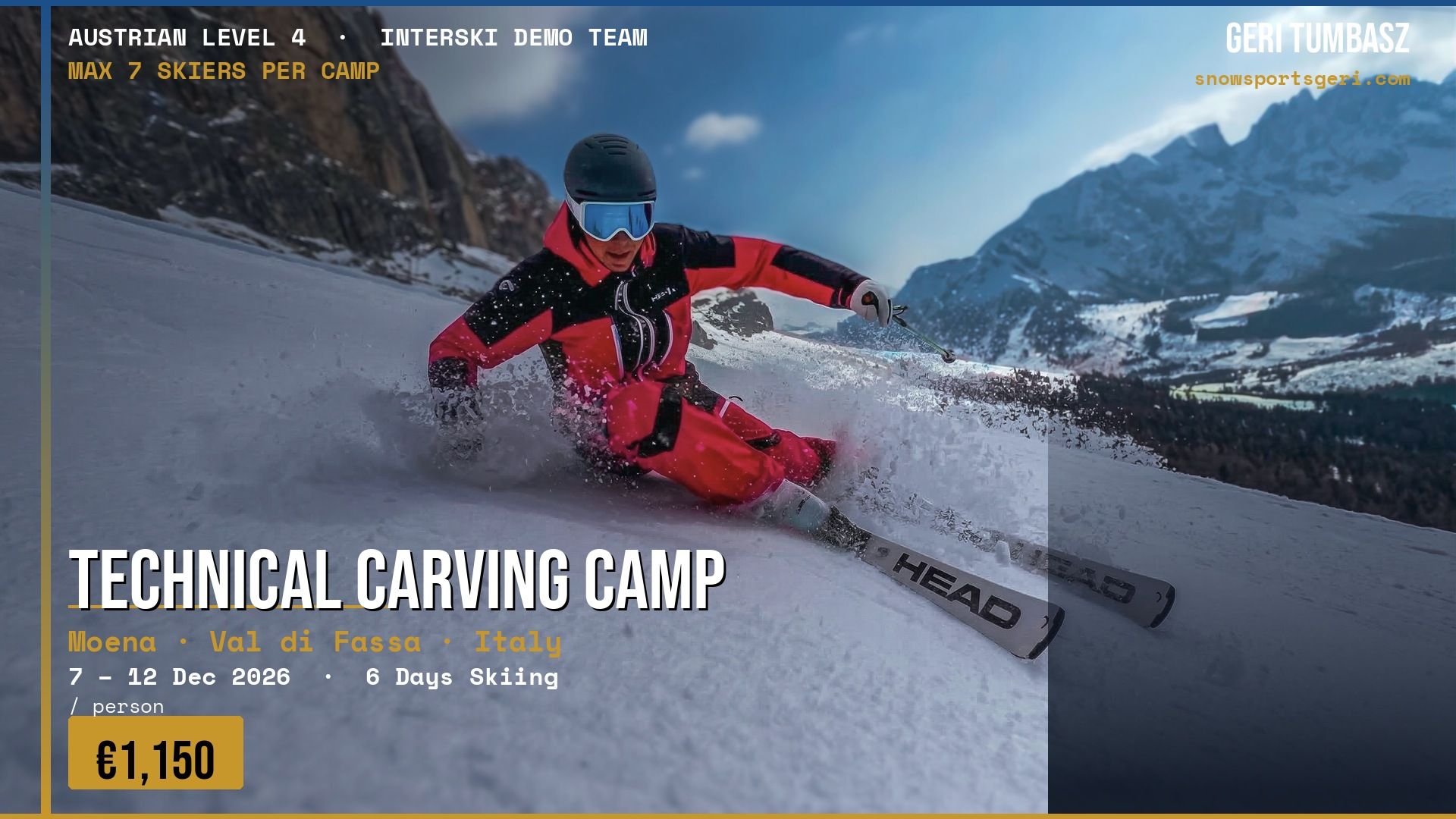
TECHNICAL CARVING CAMP Moena, Val di Fassa · Dolomites, Italy 7–12 December 2026 · 6 Days Skiing · Max 7 Skiers · €1,150 per person
Also running: Cavalese, Val di Fiemme · 14–19 December 2026 And: Moena, Val di Fassa · 1–6 March 2027
There are places in the world where skiing stops being training and becomes something else entirely.
The Dolomites is one of them.
I have been coming to this region for over 30 years. I coached here for eight seasons at the beginning of my career. I know these mountains the way you know a place you keep returning to not because you have to but because it does something to you that nowhere else quite manages.
The light in the morning on the Rosengarten. The coffee before first lift. The snow — compact, grippy, perfectly groomed — that rewards a committed carving turn more generously than almost any surface I have skied in 30 seasons and twelve countries. The pasta at the end of the day. The fact that the slopes are wide and empty and safe and the Dolomites themselves — a UNESCO World Heritage site — are the backdrop to every single run.
I take skiers to Italy because the skiing is exceptional. And because everything around the skiing makes the experience worth remembering long after the technical improvements have become habits.
Dates · 7–12 December 2026 Arrival · 6 December 2026 — afternoon Location · Moena, Val di Fassa · Dolomites, Italy Duration · 6 days skiing Group size · Maximum 7 skiers Price · €1,150 per person
Why the Dolomites
I have coached in Austria, Hungary, Holland, Belgium, Russia, Georgia, Japan, China, the USA and New Zealand. I know what different mountains offer technically and experientially. The Dolomites sits at the top of that list for one specific type of camp — carving, speed work and technical development on groomed terrain — and it is not close.
The snow here is compact and grippy in a way that glacier snow is not. When you commit to a carving turn on a Dolomites piste in December — edge angle high, pressure loaded through the outside ski, body inside the arc — the ski grips and holds and fires you through the turn with a feeling that is difficult to describe and impossible to forget once you have felt it. This is the terrain that teaches you what carving actually is.
The slopes are wide. Safety nets line the technical sections. The pistes are groomed to a standard that removes every excuse and every obstacle — what remains is you, your skis and the turn. On busy weekends in Austria you spend half your time navigating traffic. Here, especially in early December, the mountain is largely ours.
And from Moena we have access to a different ski resort every single day on the same lift pass. Six days of skiing — six different mountains, six different terrains, six different views of the Dolomites. That variety keeps the training fresh and the experience extraordinary.
The Technical Focus
This camp is built around carving — long radius carving turns, speed carving, racing line turns and the technical foundation that makes all of them work. The Dolomites gives us the perfect environment to develop this: wide groomed pistes with consistent gradient that build progressively from comfortable to genuinely demanding.
The approach here is the same as in all my camps — remove the barriers first, then raise the standard. Wide slopes mean space. Perfect grooming means grip. Safety nets on the demanding sections mean the skier can commit fully without managing fear in the back of their mind. When fear is gone, performance appears. I have seen this across 30 seasons of coaching and it is as true on a steep Italian piste as it is in a mogul corridor.
What we work on across six days:
Long radius carving The foundation. Edge angle, angulation, pressure distribution, the moment of turn initiation. Building the carving turn from a technical movement rather than a shaped arc. Feeling the difference between a ski that is carving and a ski that is skidding — and developing the sensitivity to know which one you are doing on every run.
Speed carving Taking the technical foundation and applying it at real speed on wide open terrain. This is where carving becomes visceral — where you feel the g-force through the turn and understand why this discipline produces the best all-round skiers in the world.
Racing turns — GS and SL line The technical disciplines that every serious carver should understand. Not racing preparation — technical education. The GS line teaches you about arc management and speed generation. The SL line teaches you about turn initiation, rhythm and edge-to-edge quickness. Both make your free skiing dramatically better.
Steep groomed terrain The same carving technique applied on gradient that demands commitment. This is where technical skiing gets honest — where the movement patterns either hold under pressure or reveal their weaknesses. The Dolomites gives us steep, perfectly groomed, safety-netted pitches that are ideal for this work.
Connecting it all On the final two days we ski freely across everything the region offers — varied terrain, varied gradient, varied conditions — applying the technical framework we built across the week. This is the session where it stops feeling like training and starts feeling like skiing.
The Experience
I want to be honest about something. This camp is not only about the skiing.
Six days in the Dolomites in December is an experience — not just a training programme. And I think that matters. Skiers who are genuinely enjoying where they are ski better. They are more relaxed, more open to coaching, more willing to take risks on the slope. The environment is part of the coaching.
We stay in Moena — a proper Italian alpine town, not a purpose-built ski resort. Every evening we eat at restaurants chosen for the food rather than the convenience. Italian food in the Trentino region is not the Italian food you eat at home. The pasta is made that morning. The wine is local. The atmosphere is warm and unhurried in a way that is specifically, irreducibly Italian.
Every morning we choose which mountain to ski. The Dolomiti Superski pass gives access to one of the largest ski areas in the world from a single base — Catinaccio, Buffaure, Alba, and more — all within reach of Moena. Six days, six different landscapes, all within the UNESCO-protected Dolomites.
I have been coming here for three decades. It still does something to me every time.
The Programme
On snow daily:
- Morning coaching session — 09:00 to 11:45
- Afternoon coaching session — 13:00 to 15:30
- Real-time radio coaching throughout every run (Cardo system)
- Individual video analysis every afternoon
- One day free skiing or active recovery — chosen collectively by the group
Evenings: Dinner together at local restaurants — no hotel dining. The evenings in Moena are part of the experience. We eat well, we talk skiing and we recover properly for the next day.
Accommodation
🏠 Recommended: Hotel Faloria, Moena — a classic alpine hotel in the heart of the village with spa facilities, ski storage and an ideal location for the camp week.
Alternative accommodation near Hotel Faloria is available. Book without dinner — we eat together in the evenings at restaurants I have been going to for years.
Important: Book accommodation only after the camp is officially confirmed.
What Is Included
- 6 days skiing — 5 full coaching days and 1 free skiing or recovery day
- Real-time radio coaching every session (Cardo system)
- Daily individual video analysis
- Access to multiple ski resorts on the Dolomiti Superski pass area
- Maximum 7 skiers — individual attention every run
Not included: Accommodation, lift pass, meals, travel and insurance are organised independently.
Who I Want at This Camp
Advanced skiers who want to develop their carving technique in one of the finest skiing environments in the world — and who understand that six days in the Dolomites is an investment in their skiing and in an experience worth having.
You ski confidently on red and black terrain. You have the basic carving turn in your repertoire and you want to take it somewhere it has never been — higher edge angles, more committed arcs, real speed on groomed terrain. You are open to being coached and you appreciate that great skiing happens in great places.
This camp also works exceptionally well for skiers preparing for instructor certification at any level — carving technique is examined throughout the Austrian and international systems and the Dolomites terrain is ideal preparation for any groomed snow examination.
Minimum requirements:
- Confident skiing on red and black slopes
- Basic carved turns on groomed terrain
- Ability to link short and long turns with control
- Genuine motivation to improve technically
Not sure if this is the right level? Send me one run on video. I will give you an honest answer within 24 hours.
Why This Camp. Why Me.
I hold the Austrian Staatlicher Level 4 and the Hungarian Level 4 — the highest coaching certifications in both systems. My qualifications have been formally recognised and converted by the Italian Maestro di Sci programme, IASI Ireland at Level 4 and PSIA USA at Level 3. Five national systems. One standard.
I have represented Austria and Hungary at three Interski Congresses — Cran-Montana 2003, St. Anton am Arlberg 2011, Pamporovo 2019 — and two IVSI Congresses in Lech-Zürs and Hakuba Japan, as a member of the Austrian Telemark Demo Team and the Interski Delegation. As a former examiner and coach at Snowsports Academy Austria I have assessed and certified ski instructors at the highest levels of the Austrian system.
I coached in Italy for eight seasons. I know these mountains, these towns and these slopes with the familiarity that only time and repetition produce. When I take a group to the Dolomites I am not a tour operator with a coaching qualification. I am a coach who knows and loves this specific place and has been bringing skiers here long enough to know exactly where the best terrain is, which restaurant to book on which evening and which mountain to choose when the conditions are perfect.
That knowledge is part of what you are booking.
Three Editions. Same Standard.
This camp runs three times — Moena in December, Cavalese in December and Moena in March. The programme is identical. The standard is identical. The only differences are the dates, the location and the conditions — early December glacier snow, mid-December resort snow and March spring conditions on perfect Dolomites pistes.
Choose the date that works for your season. If you want the Dolomites in all three editions — I will see you twice.
7 Places. Three Chances.
Each edition fills independently. When the spots are gone, registration closes.
The Dolomites in December. Six days. Seven skiers. One coach who has been coming here for thirty years.
Book My Spot — €1,150